For opticians and eyewear shops
Price glasses from frame, lenses and your own time
A pair of glasses is a frame, two lenses, fitting and a case. Cost each part and see the price that covers eye tests and rent too.
Quick answer: how should opticians and eyewear shops price a product?
Add every cost, then the fees that take a share of the price, then choose your margin. For single-vision glasses that works out at $118.64, leaving $65.25 profit. Skip a cost and the profit shrinks without you noticing.
Check your best seller in two minutes
Take the product you sell most. If its price was set by adding a mark-up to the frame cost and you have never counted remakes and returns allowance or insurance or voucher shortfall allowance, card fees and monthly costs, it may earn less than you think. Some items may even lose money. You will not see it in your till, only in the end-of-month result.
The mark-up trap, worked through
Marking up only the frame cost by 55% gives a price of $34.10. After the other costs and the fees taken from that price, the sale loses $13.45, not the $65.25 you planned. The same costs priced properly give $118.64.
Illustration with the example costs below. Your numbers will differ.
Where opticians and eyewear shops usually lose money
Remakes
A wrong prescription costs a second pair. Add a remakes allowance.
Lens upgrades
Cost each lens option and price the combinations.
Testing room and equipment
Spread monthly costs across the pairs you sell.
Example: Single-vision glasses
These costs go in. The price comes out of the same engine the app uses.
- Frame cost$22.00
- Lenses cost$16.00
- Case and cloth$1.20
- Fitting and dispensing time$6.00
- Card terminal fee2.9% of price
- Remakes and returns allowance4% of price
- Profit you want55% margin
Sell it for
$118.64
Profit per sale $65.25 on a total cost of $53.39.
What opticians and eyewear shops see in the app
Real screens. Your own costs and products go in, the same kind of answers come out.
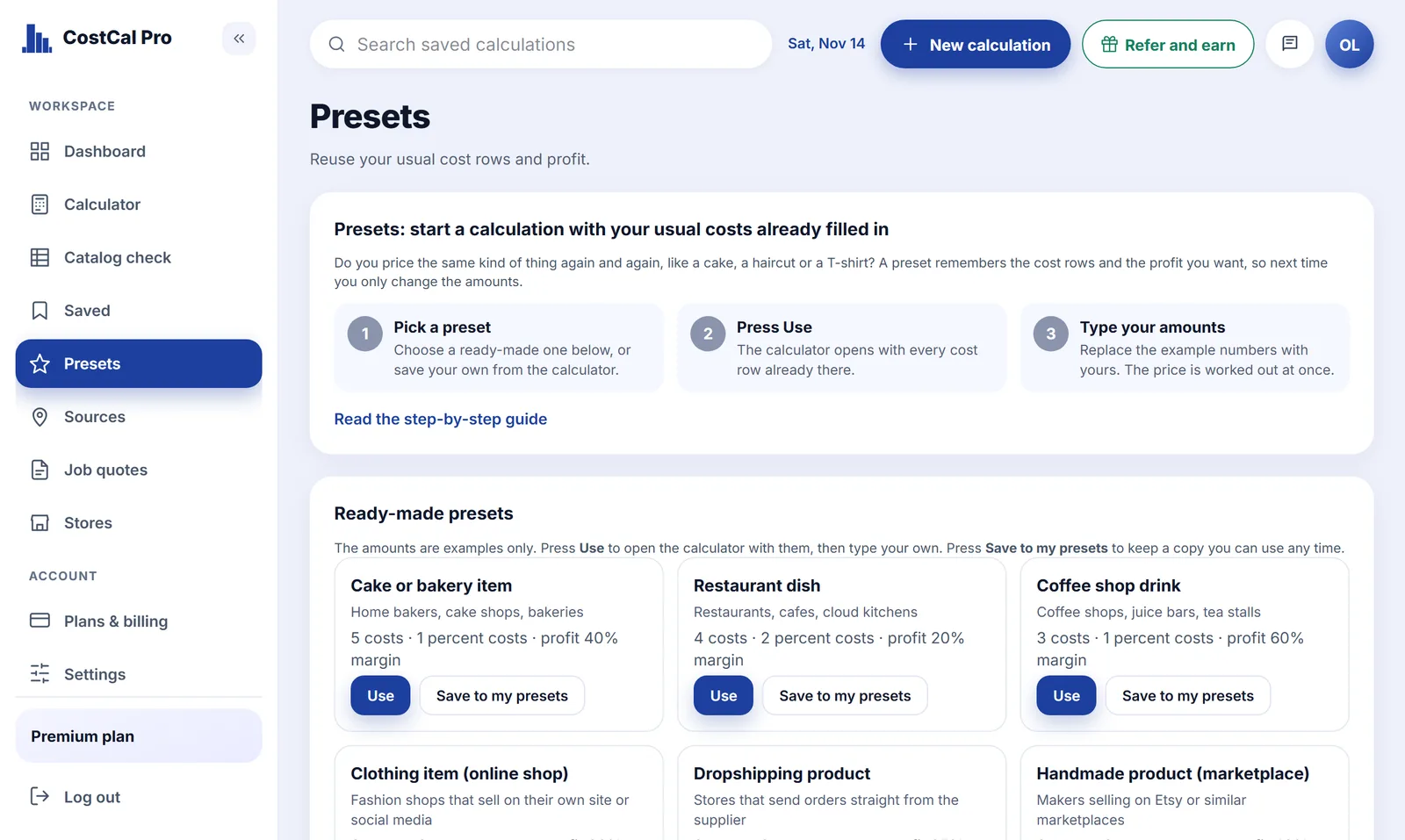
A ready cost list
Pick opticians and eyewear shops and the usual cost lines appear. You fill in the amounts.
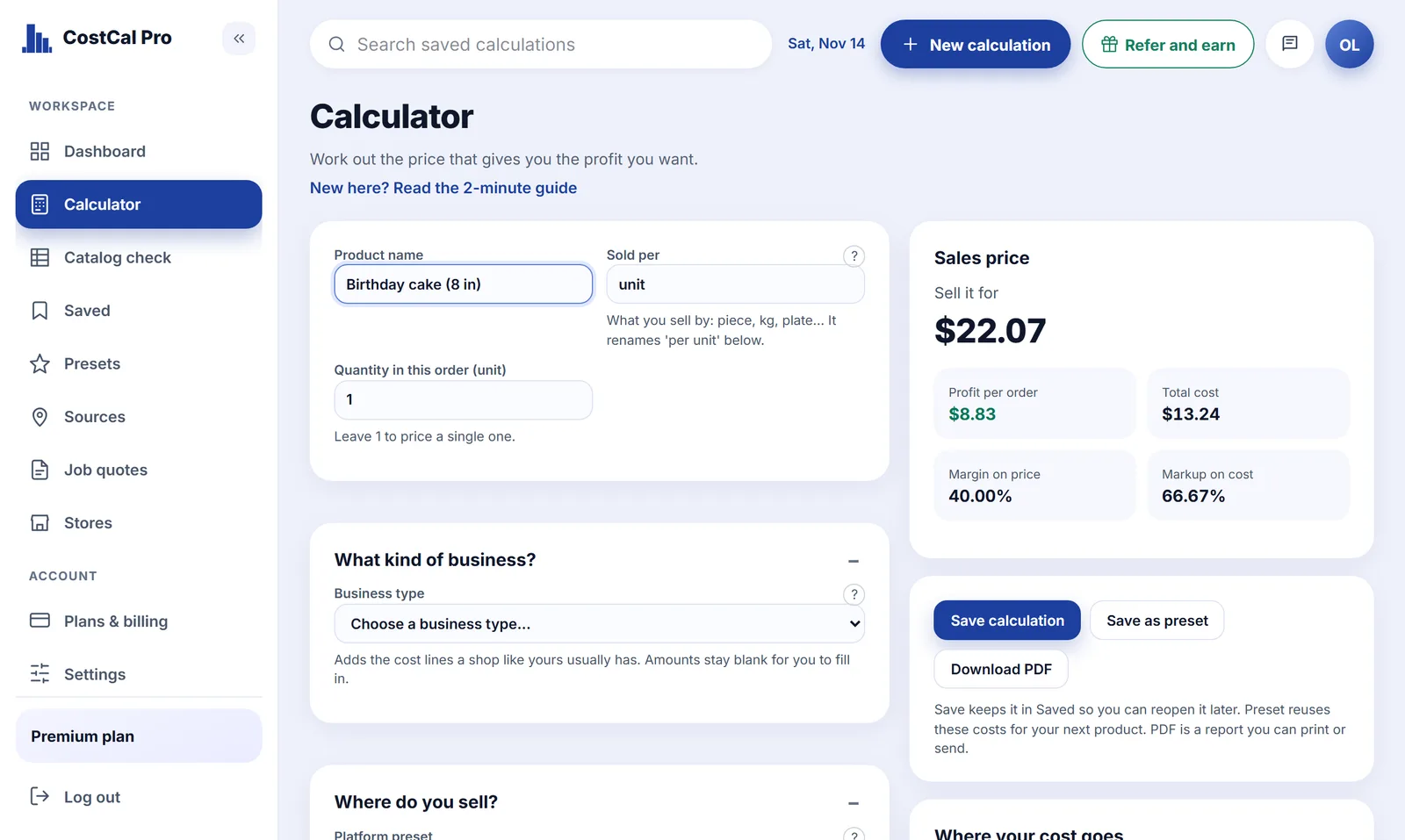
The exact price
Fees that depend on the price are solved exactly, so the profit you ask for is the profit you get.
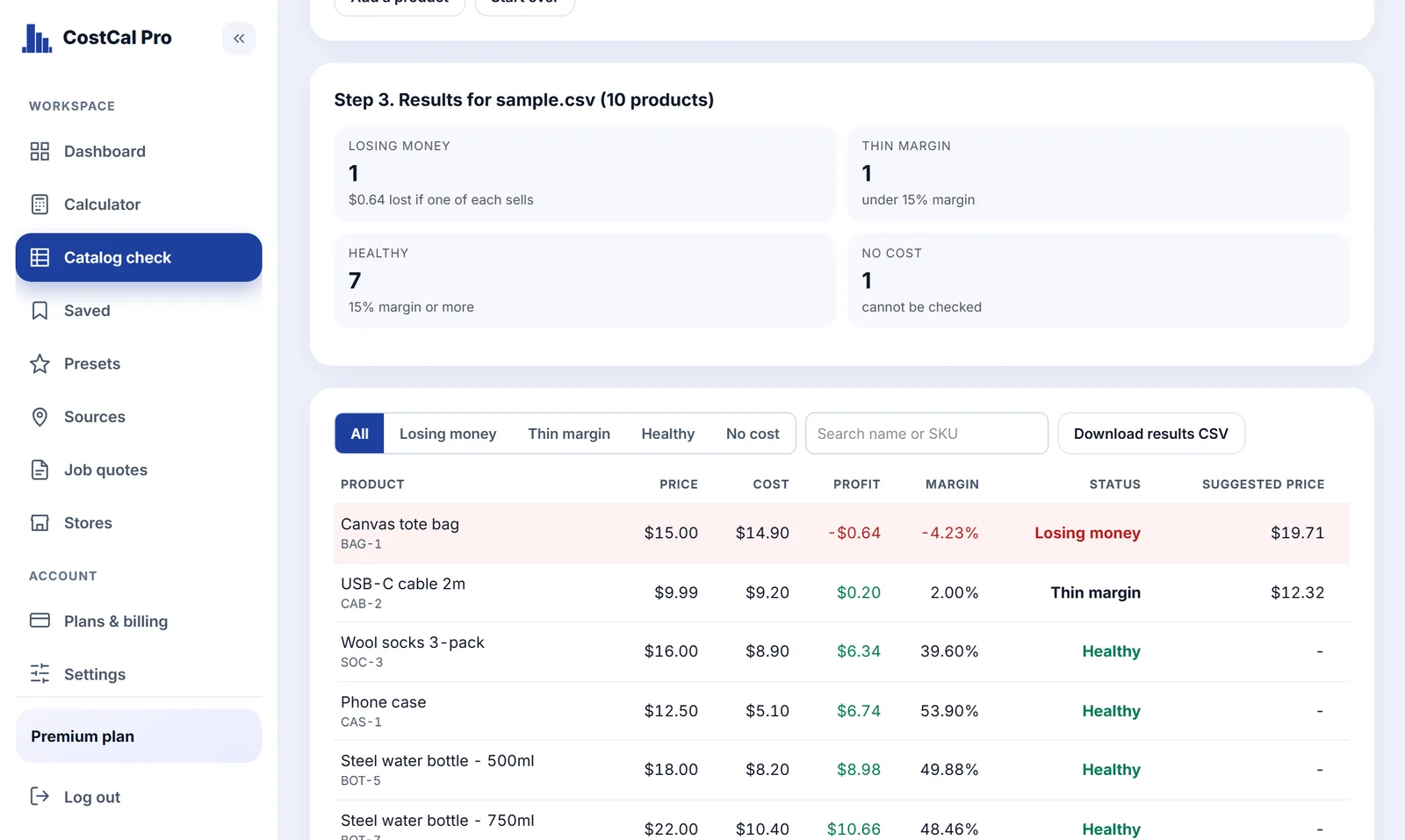
Products that lose money
Check a whole price list at once and see which items run thin or below cost.
Already set up for opticians and eyewear shops
Choose this business type in the calculator and these cost lines appear. You only fill in the amounts.
- Frame cost
- Lenses cost
- Case and cloth
- Fitting and dispensing time
- Eye test time
- Lens coatings and tint
- Card terminal fee
- Remakes and returns allowance
- Insurance or voucher shortfall allowance
- Rent (monthly)
- Staff wages (monthly)
- Equipment lease (monthly)
- Insurance (monthly)
- Test-room equipment (monthly)
- Professional registration (monthly)
What opticians and eyewear shops get with CostCal Pro
The pricing maths is free. Paid plans add bulk tools and store connections.
Exact selling price
FreeEnter the frame cost, other costs and fees, choose a margin, and get the price that keeps it.
Catalog check
FreeUpload a product export and see which products lose money or run on a thin margin.
Discount simulator
FreeSee the largest discount that still leaves a profit before you run a sale.
Break-even
FreeAdd monthly costs and see how many sales cover them.
Branded PDF report
FreeSend a clear cost and price breakdown to a customer or partner.
CSV import and typical costs
StarterBring in many products at once and start from ready cost templates.
Store connection
StarterLink calculations to products in your online store by SKU.
Weekly below-cost email
PremiumGet an email when a store product is selling below cost.
Apply prices to your store
PremiumPush approved prices to a connected WooCommerce store.
See plans and prices, all features or a sample report.
Questions opticians and eyewear shops ask about pricing
How do I price single-vision glasses?
Add every cost (frame cost, lenses cost, case and cloth, fitting and dispensing time, card terminal fee, remakes and returns allowance), then choose the profit margin you want. With these example costs and a 55% margin, single-vision glasses should sell for $118.64, which leaves $65.25 profit on a total cost of $53.39. Your own costs will differ, so enter yours in the calculator.
What is the formula for a selling price that keeps your margin?
Price = fixed costs divided by (1 minus the percentage fees minus your margin). Here the fixed costs are $45.20, the percentage fees are 6.9% of the price and the margin is 55%. Percentage fees must be taken from the selling price, not from the cost, which is why a simple mark-up on cost usually leaves less profit than planned.
What costs do opticians and eyewear shops often forget?
The easiest to miss are remakes and returns allowance, insurance or voucher shortfall allowance, your own time, and monthly costs such as rent, staff wages, equipment lease. Each one is a row in the Optician / eyewear shop preset, so you only fill in the amounts.
How do I know if a product is losing money?
Compare the selling price with the total cost, including the share of the price taken by fees. If the price is lower than that total, the product loses money. Catalog check does this for a whole product export and marks every item that loses money or has a thin margin.
Can I price different lens options?
Save one calculation per lens option and open the one you need.
Can I give a customer a quote?
Download the pricing report as a PDF.
Is the CostCal Pro calculator free for opticians and eyewear shops?
Yes. The Free plan never expires and needs no card. It includes the exact price calculation, 5 saved calculations, 5 PDF reports and a catalog check of up to 50 products. Paid plans start at $49 a year and add more saved calculations, CSV import, store connection and API keys.
Last reviewed 2026-11-11. Example figures are illustrations, not advice.
More in fashion and accessories: